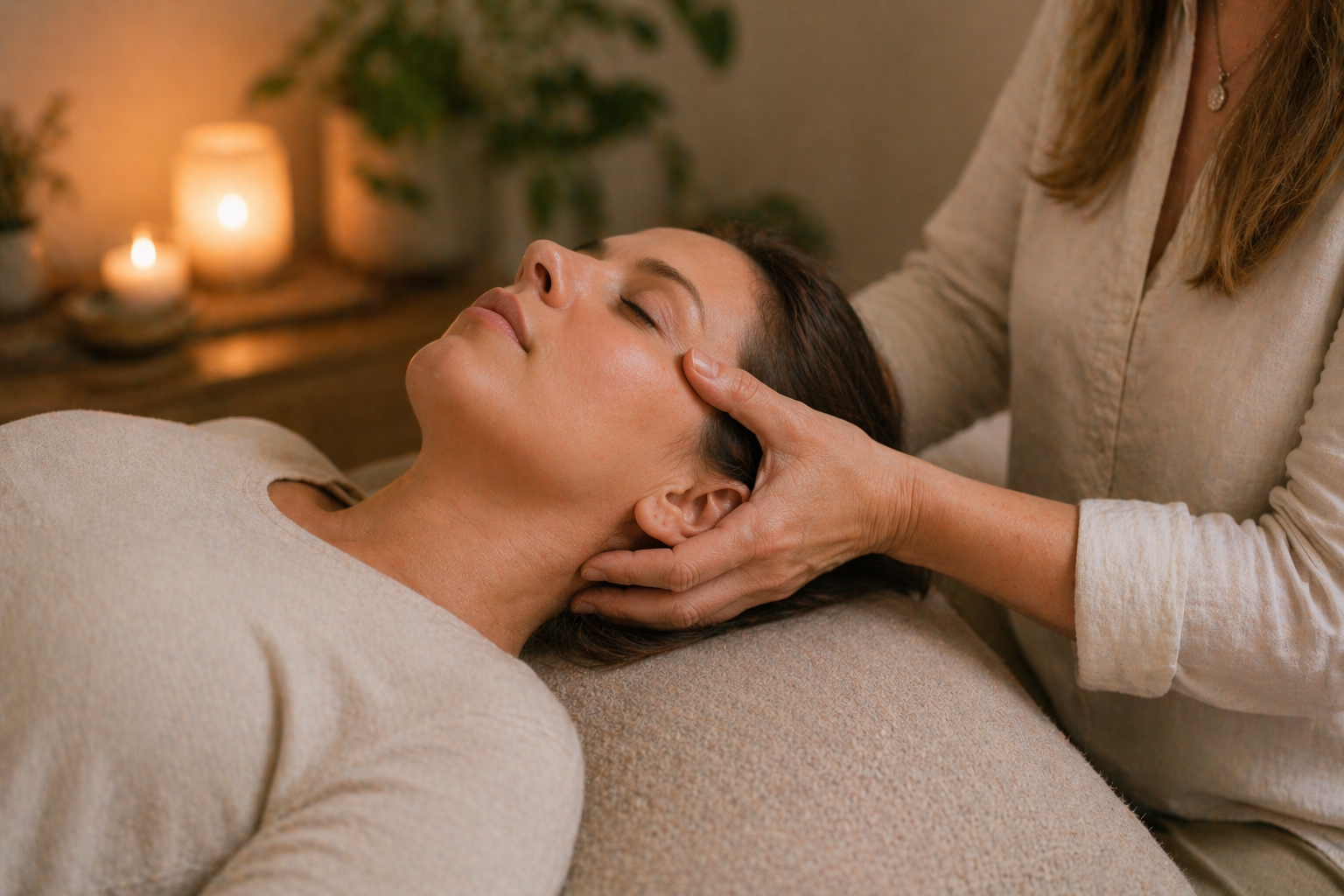

If you’ve ever wished for a therapy so gentle you could barely feel it—yet so powerful it could help release deep tension—CranioSacral therapy might be exactly what you’re looking for.
CranioSacral therapy (often called CST) is a light-touch, holistic technique that works with your body’s natural rhythms to relieve pain, calm the nervous system, and support overall wellness. While it might sound mysterious at first, the principles are simple, and the experience is deeply relaxing.
My Path to Becoming a CST Practitioner
My journey into craniosacral therapy began with a desire to support clients in deeper, more holistic ways—addressing not just muscle tension, but the nervous system patterns beneath it. I have completed Craniosacral I and Craniosacral II trainings, and I am currently working toward certification in craniosacral techniques to achieve my CST-T designation.
From there, my path will continue into SomatoEmotional Release (SER) 1 and 2, which focuses on releasing trauma and tension stored in the body, and ultimately toward the advanced CST-D designation. I’m genuinely excited to integrate this powerful modality into my practice as my skills and knowledge continue to grow.
At this time, I work with clients 18 years and older and am not accepting pediatric patients.
What Is Craniosacral Therapy?
CST is based on the idea that the body has its own subtle rhythm—known as the craniosacral rhythm—created by the movement of cerebrospinal fluid around the brain and spinal cord. This fluid cushions the nervous system and helps nourish the brain and spinal tissues.

In a session, I use gentle touch—often no more than the weight of a nickel—to assess the symmentry, quality, amplitude and rate of the CranioSacral System (which includes the bones of the skull, spine, and sacrum, plus the membranes and fluid that surround the brain and spinal cord). By detecting and releasing restrictions, we can help restore balance so the body can self-correct and heal more efficiently.
Craniosacral therapy doesn’t Chase Symptoms
One of the unique aspects of CranioSacral Therapy is that it doesn’t focus on “fixing” symptoms directly. Instead, we listen to the body and follow its natural cues. Symptoms may simply be the body’s way of pointing toward a deeper pattern or restriction. As I’ve grown in my practice I’ve learned that “holding space” is critical to working with the body in this modality. It’s beautiful work!
As CST founder Dr. John Upledger said:
“My belief is that somewhere inside of you is the answer to every question that can be asked about you. My concern is that we make a connection with that part of you that knows the answers, and that those answers can be shared with us and used for the good of the total you.”
Rather than forcing change, CST invites the body to guide the process, allowing healing to happen from the inside out.
Blending My Skills for a Unique Experience
My approach to CST is enhanced by my background in therapeutic applications of yoga, breathwork, mindfulness, and pratyahara (the yogic practice of drawing inward to heighten self-awareness). These skills complement craniosacral work by:
- Encouraging deeper nervous system regulation
- Helping clients access inner stillness more easily
- Enhancing awareness of subtle body sensations during sessions
- Supporting the integration of physical, emotional, and energetic release
My Signature Therapeutic Experience sessions blend these modalities, each session becomes more than just hands-on therapy—it becomes an immersive mind-body experience.
“My belief is that somewhere inside of you is the answer to every question that can be asked about you. My concern is that we make a connection with that part of you that knows the answers, and that those answers can be shared with us and used for the good of the total you.” John Upledger
CST in a Massage Session
You don’t have to choose between CranioSacral Therapy and traditional massage—they can work beautifully together. I often integrate CST techniques into a standard massage, weaving in moments of stillness and gentle CranioSacral holds between more familiar massage strokes.
This combination can:
- Help the nervous system drop into a deeper state of relaxation
- Release tension that might not fully respond to massage pressure alone
- Create a more lasting sense of ease by addressing both muscle tissue and the underlying nervous system patterns
Whether you book a full CranioSacral session or request it as part of your regular massage, CST can enhance the effects of bodywork and leave you feeling balanced from the inside out.
The Benefits of Craniosacral Therapy

Because CST focuses on the nervous system, it can have wide-reaching effects on both body and mind. Research and client experiences suggest benefits such as:
- Reduced pain and tension – Helpful for headaches, migraines, neck pain, TMJ issues, and chronic muscle tension.
- Nervous system regulation – Supports a shift from “fight or flight” stress mode into “rest and digest” healing mode.
- Improved sleep and relaxation – Many clients report sleeping better and feeling calmer after a session.
- Support for trauma recovery – The gentle nature of CST can be especially helpful for releasing stored physical and emotional tension related to past injuries or stress.
- Enhanced overall wellness – By promoting balance in the craniosacral system, CST encourages the body’s innate ability to heal itself.
Who Can Benefit?
CST is safe for most adults and can be tailored to meet individual needs. It’s often used to support recovery from concussions, manage chronic pain, assist with post-surgical healing, or simply as a preventive wellness practice.
A Gentle Invitation to Healing
Craniosacral therapy isn’t about forcing the body into change—it’s about listening deeply to what it needs and creating space for natural healing to occur. Whether experienced on its own or seamlessly woven into a massage, CST offers a gentle, yet powerful, pathway to restoring balance and vitality.
If you’re curious, I’d be honored to share this work with you. You might be surprised by how much change can come from such a light touch.
Leave a Reply