
If you’ve ever seen an athlete or someone leave a massage looking like they lost a mildly aggressive encounter with sea life… congratulations—you’ve witnessed traditional dry cupping.
If you haven’t, that visual alone may deter you from ever wanting to seek out that kind of therapeutic treatment.
Is dry cupping helpful? Yes.
Is it subtle? Not even a little.
Now.. this wasn’t a great introduction.. for one of my most favorite.. most sought after therapeutic modalities, so I want you to stick with me for a moment.
There is a way to keep you from walking out of my studio without looking like you have personalized crop circles all over your body.
Enter: dynamic (gliding) cupping—
where you get all of the benefits of traditional dry cupping, without the circular evidence.
A Brief (and Slightly Weird) History of Cupping
Before silicone cups, glass domes, and Instagram wellness trends…
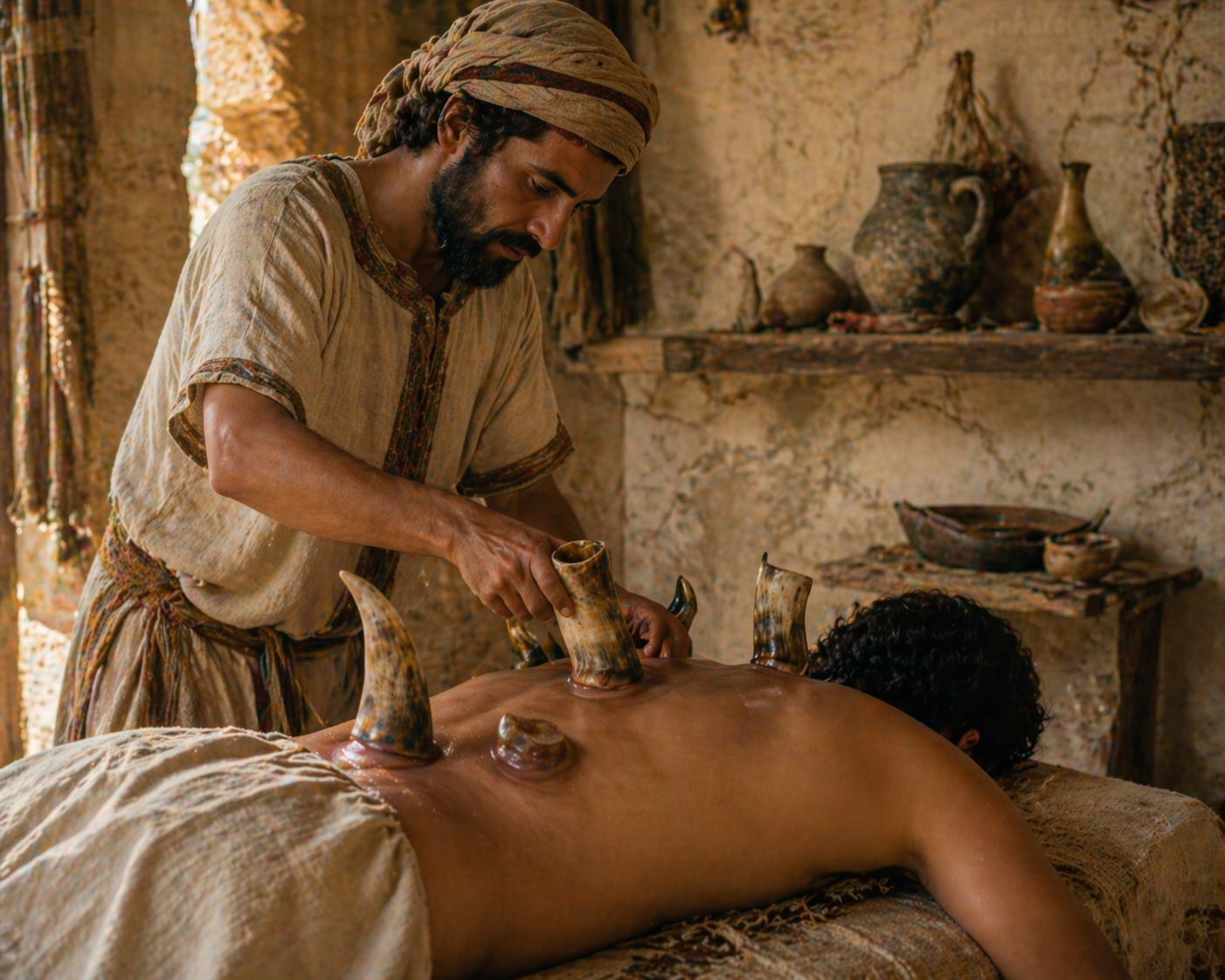
there were animal horns.
Yes. Actual horns.
Early forms of cupping show up across multiple ancient cultures:
- Ancient Egypt (hello, Ebers Papyrus circa 1500 BCE)
- Traditional Chinese Medicine
- Greek and Arabic medicine

One of the earliest methods involved hollowed-out animal horns placed on the skin and is still practiced in some cultures today. Practitioners would create suction by:
- heating the air inside
- or (brace yourself) using their mouth to draw out the air (I die.)

Which means at one point in history, cupping was essentially:
“therapeutic horn suction”
And here’s the part most people don’t realize:
Horn cupping is still practiced today in certain traditional and rural settings around the world.
So this isn’t just ancient history—it’s a technique that never fully left.
Over time, however, glass cups replaced horns, often using fire to create suction (the classic “fire cupping” you’ve probably seen). Eventually, most healthcare professionals utilize:
- silicone cups
- plastic vacuum pump systems
- and techniques that are a little less… let’s say medieval-adjacent
So what is dynamic cupping?
Dynamic cupping is similar to traditional cupping in that it utilizes negative pressure. This basically means that it creates a vacuum-like pull that lifts the skin and tissue upward instead of pressing down into it. Most bodywork (like massage) uses compression—pushing into the body.

Cupping flips that.
It gently pulls the tissue up and away.
With dynamic cupping, instead of placing cups and letting them sit there like palm-sized Dementors sucking the soul out your tissues… dynamic cupping involves gentle suction and slow, intentional movement.
The cup lifts the skin slightly, then glides along muscles and fascia.
It can feel a little strange at first—like your skin is being… reorganized? realigned? (not sure what the correct word is here..) —but most people land somewhere between “this is weird” and “okay wait, I love this…. my body feels ah-mazing!!!”
“Lymphatic Cupping”

There’s been a growing trend to frame cupping—especially gliding cupping—as a lymphatic drainage tool.
And this is where we gently… recalibrate.
In truth, dynamic cupping can:
- Improve tissue glide (fascia that’s less clingy, more cooperative)
- Support circulation
- Reduces that “everything feels stuck but I can’t explain why” sensation
- Helps the body feel lighter, more responsive, more aligned
But its primary effect is still:
tissue motility + local perfusion
And it has to be done with much lower pressure than traditional cupping.
But cupping does not directly affect lymphatic drainage or detoxification.
I know, I know… let’s take a deep breath and virtually un-clutch those pearls. Let me explain.
Remember our previous blog post?
If not then here’s the Cliff’s Notes version..
Cupping affects blood circulation and the motility of our tissues.. when tissue moves well → Fluid tends to move better too
So when it comes to cupping…it’s basically creating better conditions for movement of lymph through the lymphatic system.
Which I get it.. simplifying this makes it a whole lot more difficult to mentally overcome those suction marks and jump on the cupping train, but it’s definitely, 100% significantly more accurate.
What Ayurveda Has to Say (Let’s Translate This a Bit)
Hear me out… I LOVE it when the Eastern body and Western mind overlap!
Before we go full Sanskrit, let’s pivot to some Ayurveda 101.
First, Ayurveda is a traditional system of medicine that looks at health through patterns of:
- movement
- stability
- transformation
In modern terms, you can think of it as observing how your body tends to respond:
- fast or slow
- dry or fluid
- energized or depleted
Ayurveda organizes these patterns into three primary “types” (called doshas):
Kapha → structure, stability, fluid retention
Vata → movement, variability, nervous system activity
Pitta → metabolism, heat, transformation
So where does cupping fit into this?
From an Ayurvedic lens, cupping can:
- Help reduce Kapha-like stagnation (heaviness, sluggishness)
- Gently support Vata when done with care and grounding
The gliding motion supports:
- circulation (rakta)
- movement of energy
- reduction of that “stuck” feeling (hello, Ama)
No—cupping is not a classical Ayurvedic treatment.
But the principles overlap beautifully:
- Ayurveda says: restore flow, reduce stagnation
- Modern physiology says: improve tissue mobility and circulation
But it plays surprisingly well with the philosophy of the Dhatus. Primarily on the first two dhatus (Rasa/Rakta) and supports the overall vitality of the remaining tissues (Mamsa, Meda, Asthi, Majja, Shukra) by removing obstructions (Srotasavrodh) and improving nutrient transport.
Which—if we’re being honest—is kind of the whole theme here.
To Summarize… What can it help with?
- Muscle tension (without feeling like you’ve been attacked)
- Fascial restriction (the muscle sock for your muscles.. and all of your muscle fibers.. basically encasing almost everything)
- Mild fluid retention
- Post-workout recovery
- That vague, unexplainable “I feel off.. sluggish.. tight and restricted” feeling
Also:
…stressed humans
…over-scheduled humans
….humans who forgot how to fully exhale
So… basically most of us.
FAQ
Will it leave marks?
Usually not. Because the cups are moving, you’re less likely to get the dramatic circles. If anything shows up, it’s typically mild—more “rosy glow” than “documented incident.”
But I can’t make any promises.. so much of it depends on your hydration levels.. histamine response.. etc. Everyone is different
Does it hurt?
It shouldn’t. Think: stretch + glide + pressure. If it hurts, just let your practitioner know and they should adjust.
If not, perhaps find another practitioner.
This shouldn’t be a “do you want your glass of suck it up warm or cold” situation.
Can I work out after?
You can… but your body might file a complaint.
My recommendation? Maybe opt for a Restorative, Yin or Yoga Nidra session instead.
It’s a great opportunity to let your body dedicate resources to where it needs to heal an restore itself. Better to hydrate, move gently, and let things settle.
Can everyone try cupping?
Dynamic cupping is gentle, but not for everyone. Avoid or consult a professional if:
- You have skin infections, rashes, or open wounds
- You bruise easily or are on blood thinners
- You’re pregnant (without proper training/support)
- You’ve had recent surgery in the area
Final Thoughts: Let It Move (Not Force It)
Cupping is a powerful tool—but not for the reasons the internet likes to shout about.
It doesn’t:
- pull toxins out
- override your lymphatic system
- or magically “fix” everything
What it does do is quieter—and honestly, more effective:
it changes pressure
it creates space
it supports how your tissues and fluids already know how to move
And sometimes, that’s exactly what the body needs.
Not more force.
Not more intensity.
Just better conditions for the body to do what it does best!
Ready to experience it for yourself?
If your body has been feeling:
- tight
- heavy
- a little “stuck” in ways you can’t quite explain
…it might not need more pressure.
It might need a different approach.
Come experience dynamic cupping as part of a customized Adaptive Relief Clinical Massage Therapy session designed around how your body responds—not a one-size-fits-all protocol.
Book your session
Or explore how cupping fits into your wellness plan
Thoughtful, evidence-informed care that meets you where you are.
Leave a Reply